Wednesday, September 19, 2018

SHOW This Sunday!


This looks like a very interesting show that would also give you a great overview of different types of theatre. AND...sounds like it's a great show too! I would like to attend and hope some of you will come too! 

(translated from Portuguese -- original LINKed here)

The Alfa Theater features a cultural entertainment option for the kids: Doing Scene - Invasion of the Backstage . The activity includes the performance of a show followed by a walk through each area of ​​the theater. The activity begins with the presentation of the piece Caixa Mágica . Two technicians (the actors Sidnei Caria and Thiago Andreuccetti) tell the story of the dramatic art in a fun way and from the perspective of who is behind the stage. They begin by showing an incredible model of the Greek theater, which was done outdoors, only by men and masks. 

They go through the ritualistic characters of the Japanese theater, the troubadours of the medieval era and the commedia dell'arte to the Elizabethan theater, realistic theater and contemporary theater. Still part of the plot is an unusual escape behind the scenes and an amazing ending! 

During the escape, the spectators will go through the dressing rooms, under the stage and in the technical part of the theater. Then the technicians (really), will show the operation of the sound, the lighting and the stage machine.

"We will explain how a spectacle is built to provide the spectator's involvement in every story that is told after the curtains are opened," reports Haroldo Costanzo, Technical Assistant. All explanation will be made by the Technical Team of the Alfa Theater, winner of the APCA 2016 (Paulista Association of Art Critics) Award.

"This experience was born from our Social Project Discovering the Theater , which takes place 15 years ago in the Alfa Theater and aims to present to young people all the professions of the scenic universe, to awaken in them the interest for the arts and also the formation of new audiences "says Elizabeth Machado, Superintendent of the Alpha Institute.

"It's a unique, unique and very consistent product because it already has 15 years of Discovering the Theater baggage, plus the award-winning presentation team," says Elizabeth

R$40 (student ticket)

Tuesday, September 18, 2018

Personal Inventory

Theatre in Context
Nothing is done in a vaccuum, this includes our next unit--The Collaborative Project!  We all bring different SKILLS, INTERESTS & APPROACHES to our work.  It's important as we are about to embark on making an original piece of theatre that we discuss our personal inventory and think about how we approach the process.

Example of Personal Inventory
This is a quick example I made yesterday of a personal assessment. I would encourage you to be creative with your piece. Notice this was handwritten and then scanned in! Take some risks and be creative with your portfolio!

Source: thinkaheadprint/media

Save Future Self!
Think about FULFILLING the requirements NOW, not later.

EXPLAIN -- I think that it's a bit simple and needs to be quite a bit more detailed with explicit examples. This would be outlining or, maybe, describing. It definitely would NOT receive the highest marks--explaining.

CONNECT TO YOUR EXPERIENCES -- I only list the theatrical experiences here. I should be much more explicit and explain all of the different things I have learned about (at workshops, classes, trainings and shows I have seen.)

Homework: Please complete your personal inventory and add to your blog! Copy the link in the comments below.

My Personal Inventory from IB Journal
Source: E. Grimes, Sept. 2018


Devising Theatre Companies

For this element of Theatre in Context, you will need to research and write about the theatre companies' devising process. Think about the possibilities of how you believe these approaches could possibly be used in your own Collaborative Project.

I would encourage you to find an image/example of their work in action. It would be beneficial if you found a workshop, game or activity that the group worked with (so you could possibly use it in the future.)

Devising Theatre Companies Possibilities
Theatre companyWebsite
http://www.age-exchange.org.uk/
http://www.belgrade.co.uk/
Complicite
Dell ‘Arte International
Teatro de Creación
DV8 Physical Theatre
Fevered Sleep
Forced Entertainment
Fork Beard
Frantic Assembly
Fuel
Gecko Theatre
Greenwell & Lewisham Young People’s Theatre
Goat Island
Gob Squad
Grid Iron
Improbable
Invisible Flock
Invisible Thread
I O U
Ex Machina
Lone Twin
Massive Company
Wrights and Sits
Northern Stage
Theatre Passe Muraille
People Show
Pintsize Theatre Company
Pirate Productions
PotatoRoom Productions
Reckless Sleepers
Red Ladder Theatre Company
Rude Mechanicals
Shunt
Space Hijackers
Stan’s Cafe
Station House Opera
Tangled Feet
Théâtre du Soleil
Theatre O
The Paper Birds Theatre Company
The Red Room
The Wooster Group
Third Angel
Trestle
http://www.trestle.org.uk/

Saturday, September 15, 2018

The Collaborative Project

Over the weekend, please take some time to review the Collaborative Project in the IB Guide starting on page (70-77). (Look to the sidebar for the IB Syllabus Link ----->)

Also check out examples of Collaborative Project Portfolios below: 

collaborative_project_sample_1.pdf Download File
collaborative_project_sample_2.pdf Download File

Write a blog post to your self explaining your understanding of the task requirements. Be sure to included:
  • What do you need to do for the task? 
  • What evidence do you have? 
  • What are the time / page / word limits?
  • What are your questions/concerns about this task? 
  • How are you feeling about this task?
Once you have written the blog post on YOUR blog, please link the page in the comments below here! 

Friday, September 14, 2018

AMDA Workshop!

I hope you enjoyed the experience of working with AMDA's Kathy Morath & Christopher Stephens. It was wonderful to see you each gain confidence with yourselves, in both your singing and acting. I hope that this experience helps you not only for this one song, but also as you continue with performing.

Please take some time to reflect on the experience in your journal or online journal. Think about the feedback you received from the instructions and how you might apply this in the future!

Here are some photos/videos from the workshop:


Here's the extended overview of AMDA, if you are interested:

Wednesday, September 5, 2018

Year 1 Summative -- What do I know now?


LINK to Assignment Details
Intro to IB Theatre & The Journal

Essential Question: Throughout this introductory unit, what have you learned about how to examine theatre, specifically within the IB Theatre course?

Learning Targets:
  1. I am able to articulate the goals and expectations of the IB Theatre course.
  2. I am able to use Vibrant Voices and other resources effectively.
  3. I am able to use the journal and online journal to effectively to maintain notes, inspirational images/ideas & individual reflections.
  4. I am able to reflect upon classroom exercises thoughtfully.
  5. I am able to articulate the director’s process of planning a production.
    1. I can identify, describe and reflect upon a moment of TEAM.
    2. I can devise a director’s concept.
    3. I am able to identify design elements & color theory in productions.
  6. I am able to reflect on my own learning and growth in the course.
  7. I am able to cite images correctly. *This will be addressed through how you cite the sources/images in the previous standards. You do not need to create a separate reflection for this area.

For each of the Learning Standards, you should be able to include a reflection & citation from one (or more)  of the activities we have done that demonstrates your success with this target.


Monday, September 3, 2018

Director's Notebook

I will make sure to get my comments back to you ASAP, but in the meantime, we will evaluate one another's work. Over the course of the two days, I hope you be able to read and comment on all four of your peers' work.

BE SURE TO USE THE RUBRIC to evaluate your part of the Director's Notebook. Use post-it notes or comments (online) to ask any clarifying questions or to point out concerns. If it's not clear to you, be sure to point it out!

DIRECTOR (ACROSS) ---> Chloe's DN Isa's DN Jenny's DN Maria Eugenia's DN Sofia's DN
READER (DOWN)          
Chloe reads… x Part D Part C Part B Part A
Isa reads… Part A x Part D Part C Part B
Jenny reads… Part B Part A x Part D Part C
Maria Eugenia reads.. Part C Part B Part A x Part D
Sofia reads… Part D Part C Part B Part A x

Sunday, September 2, 2018

Color & Color Theory

Many times designers will use color to create an association with that color to a concept or mood. There are some physiological and cultural meanings and symbolism for color. For example:
Red Mood Board courtesy of: advocate-art.com
What words do we associate with the color red?

Think about: What does each color symbolize?


THINK ABOUT:
What is something interesting you learned, realized or pondered from watching this video?
What is one thing that this video made you wonder about regarding color and design?


What role does COLOR play in costumes? 

Strong use of Color to bring the OZ characters together in "Wicked"
Source: wickedtour.co.uk


What about COLOR SCHEMES? 

Use of Complementary Colors:
These are colors that are directly opposite one another on the color wheel. The use of complementary colors creates a strong contrast, for those who are wanting to stand out!

Complementary Colors:
Red & Green
Blue & Orange
Yellow & Purple

Complementary Colors (Courtesy of Luis Ferriera)


Split Complementary Scheme: 
Strong choices with an accent choice. Looks well put together.

Split-Complementary Color Scheme for Fish
Seussical The Musical
Use of Analogous Colors--This is when you use 3 colors that are next to one another in the color wheel. This helps to create a balanced, yet put-together look.

Analogous Colors:
Analogous Colors (Courtesy of Luis Ferriera)

Analogous color costumes for Whoville Citizens
Seussical The Musical


Monochromatic Scheme: 
This color scheme helps to create a strong connection with the color and its symbolism, without overwhelming the eye. 


Paper Dolls: 
For your three paper dolls, develop a character description for each character. Think about what you want to reveal about his/her personality.

Using your character descriptions, create a color design for the character. You must use three of the four color schemes: 
  1. Monochromatic
  2. Complementary OR Split Complementary
  3. Analogous


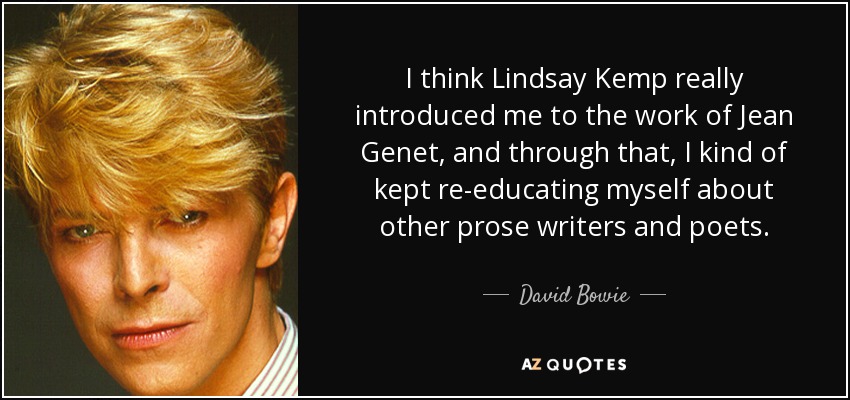
RIP Lindsay Kemp

Lindsay Kemp performing in 2002.
Photograph: Tristram Kenton for the Guardian (theguardian.com)

Lindsay Kemp, Dancer Who Taught David Bowie, Is Dead at 80


By Alex Marshall
  • Lindsay Kemp, a boundary-pushing British dancer, choreographer and mime who taught David Bowie and Kate Bush how to move, died on Friday at his home in Livorno, Italy. He was 80.

  • Ms. Bush, in a statement posted on her website, said: “To call him a mime artist is like calling Mozart a pianist. He was very brave, very funny and, above all, astonishingly inspirational.”

  • Mr. Kemp may have been an inspiration to two of the most important musicians of the 1970s, as well as to countless dancers, but his work — often filled with sex and blood, and with clear nods to its inspirations — was received less favorably by some critics. (Keep reading the NYTimes article here.)
Link to Lindsay Kemp's Videos of Performances
(including Jean Genet--a "Flowers")

Lindsay Kemp Obituary & A Life in Pictures (The Guardian)
Image result for jean genet lindsay kemp
Image: azquotes.com

Wednesday, August 29, 2018

Year 1: Visual Research for Set Designs

In order to build your repertoire of Theatrical Set Design, I'd like you do some Visual Research in which you find sets that are interesting and intriguing. These can be from shows that you've seen (or not). Just be sure to include the correct citation.
Be sure to include an explanation as to why you were inspired to choose this particular set and what stands out for you. Label each image according to which criteria you used.  

Ensure that the images are in the LARGEST setting possible (without overtaking the whole page).  Each piece must must include the following citing information: 
1) Source (What website did you get it from?)
2) Title of the Play that the Set Design 
3) Theatre Company that produced the play
4) Set Designer
5) Date of Production

You can find the images anywhere, but here is a link to Set Designers may be helpful (but be aware that you might need to click around): Theatre Links. 

Try to find 10 Sets that meet the following criteria:
1) Set that clearly demonstrates MOOD
2) Set that excels with its use of a strong COLOR SCHEME
3) Set that uses LIGHT (and/or Shadow) to set the stage
4) Set that with a strong sense of LINES
5) Set that uses TEXTURE effectively
6) Set that clearly marks MODERN REALITY  (REALISM)
7) Set that show the REALITY of a HISTORICAL TIME PERIOD (REALISM)
8) Set that shows an ABSTRACT idea or CONCEPT (SYMBOLIC)
9) 2 sets that you particularly enjoy 

____________________________________________
FOR EXAMPLE: 
Medea - Set design by R. Finkelstein
"Medea" designed by Richard Finkelstein for James Mason University's production in 2007
(Image courtesy of: rfdesigns.org)
Abstract Design: This is an abstract design because the broken tiles, along with the gauzy background is not realistic. I really appreciate this design because it puts in a place, with space to work in without being a realistic. The tiles suggest a Mediterranean locale-- Greece? One assumes with the Greek myth of Medea this is Greece. The broken pieces and fractured stage also suggests that the time period is turbulent and falling apart.  I'm sure it was an extremely time consuming process to realize (especially the design within the tiles). 


Stage A Moment of Theatre

As you think about staging your moment of theatre, think about how you will create the

  • Tension
  • Emotion
  • Atmosphere 
  • Meaning
For your two moments, try to find CONTRASTING moments to highlight! 
Staging of "Hello Little Girl"
From "Into the Woods"
Courtesy of Emily Grimes

Possibilities for BLOCKING:
Staging Configurations: Proxemics
Courtesy of: Black Box Education
YEAR 2: FULLY COMPLETED DRAFT DUE MONDAY! 

Tuesday, August 28, 2018

Year 1 -- A Scene With a Tree

How can one object change depending on the mood?

In our exercise today, I asked you to draw a scene with a tree. Depending on the moods, your trees changed shape, colors and forms.
My Scenes with a Tree Drawings
Image courtesy of Emily Grimes

For homework, please draw one more tree with a guiding mood/word.  Afterward, take a picture of your 6 trees and add a reflection to your blog.

Reflect on this exercise: 
What do you notice about the different trees? What impact did the GUIDING MOOD/PHRASE have on your drawings? What do you notice about LINES, COLOR and SHAPE/FORM? What did you learn from this exercise? Did you enjoy the exercise? Why or why not?

Copy the link in the comments below!