 |
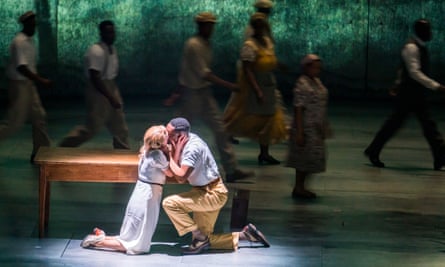
| A landmark in the National Theatre’s history’ ... Amy Forrest (Mrs Ryder) and CJ Beckford (Michael) in Small Island. Photograph: Tristram Kenton/the Guardian |
My Reaction: It felt like a gut punch to see Queenie not only left behind, but that the married fellow schoolteacher to be the one that Michael chose. You wonder, will she make it? Of course she will. This is another example of how she becomes stronger.
Significance: Repeatedly we see that Queenie is a stubborn, strong-willed woman. Her stalwart demeanor has cost her love and friendship, but in the end, it's this attitude that allows her the opportunity to go to England. This rejection builds her resolute manner.
__________________________
 |
| Hortense & Bernard - photo by Brinkhoff/Mögenburg (standard.co.uk) |
 |
| Hortense & Queenie meeting - photo by: Brinkhoff/Mögenburg (standard.co.uk) |
My Reaction: There is so much going on here. We see the openness and friendliness of Hortense to Blacks (which is clearly rare that this time) contrasted by Bernard's outward racism and dismissive nature. Both he and Gilbert had served in the military fighting the same war, but he cannot hide his hatred. We love Hortense for her willingness to help Gilbert and Queenie and continue to find Bernard just an awkward, unlikable guy. On top of this, we ache for Hortense because she's been doing her best with her husband gone. We assume he is dead, like she has, and feel she has the right to love and have this baby. With him in the picture, though, it changes things. We're wondering, what will happen next?
Significance: This is a turning point of the play. We fear that Gilbert and Queenie are going to be kicked out of the one place that they have been welcome, further straining this "dream" that they have had. We question race relations -- how will Hortense be able to care for a interracial baby during this time period? What allegiance does Hortense have to Bernard? Bernard represents most of the British society -- rejecting Blacks despite who were part of the Commonwealth and even fought in the warsd defending the country.

No comments:
Post a Comment