Tuesday, February 8, 2022

Sunday, July 5, 2020
Small Island - National Theatre (TEAM)
Official Trailer:
On Stage: The wind howls, the trees bend in the backgroun, the shadows of people rushing here and there. the revolve moves everyone which way. The main character, Queenie, catches herself in the doorway, standing tall and sure that her love (her cousin, Michael) will come to save her in the school yard. The white woman, a fellow teacher, glamorizes the hurricane and seems the epitome of a naive tourist, gaping at the "exotic" hurricane as a fascinating experience rather than a life altering event. The two characters, stand in contrast to one another. Michael arrives and we assume it's for Queenie, but no, we see the white school teacher and Michael entwined in a lover's embrace under the school desks, while Queenie watches in shock.
My Reaction: It felt like a gut punch to see Queenie not only left behind, but that the married fellow schoolteacher to be the one that Michael chose. You wonder, will she make it? Of course she will. This is another example of how she becomes stronger.
Significance: Repeatedly we see that Queenie is a stubborn, strong-willed woman. Her stalwart demeanor has cost her love and friendship, but in the end, it's this attitude that allows her the opportunity to go to England. This rejection builds her resolute manner.
__________________________
On Stage: In the UK, Hortense believes her husband (Bernard) to be dead from the war. She has had to take in renters, including several Jamaican immigrants (including Gilbert and Queenie). She has also fallen in love with Michael (yes, the same one before), but it seems he has gone to war or left? On this day, we see Bernard arrive through the door. Hortense is shocked and Gilbert comes to check on her. Gilbert is appalled to see them in his house and kicks them out. Hortense begins screaming and kicks out both Gilbert and Bernard but demands that Queenie stay. With the door shut, we realize that Hortense is in labor. Queenie is forced to take on the role of mid-wife although she is hesitant to do so. Crudely, we see Hortense on all fours with Queenie encouraging Hortense to push. The baby is born and Queenie stands up with blood staining her all white dress.
My Reaction: There is so much going on here. We see the openness and friendliness of Hortense to Blacks (which is clearly rare that this time) contrasted by Bernard's outward racism and dismissive nature. Both he and Gilbert had served in the military fighting the same war, but he cannot hide his hatred. We love Hortense for her willingness to help Gilbert and Queenie and continue to find Bernard just an awkward, unlikable guy. On top of this, we ache for Hortense because she's been doing her best with her husband gone. We assume he is dead, like she has, and feel she has the right to love and have this baby. With him in the picture, though, it changes things. We're wondering, what will happen next?
Significance: This is a turning point of the play. We fear that Gilbert and Queenie are going to be kicked out of the one place that they have been welcome, further straining this "dream" that they have had. We question race relations -- how will Hortense be able to care for a interracial baby during this time period? What allegiance does Hortense have to Bernard? Bernard represents most of the British society -- rejecting Blacks despite who were part of the Commonwealth and even fought in the warsd defending the country.
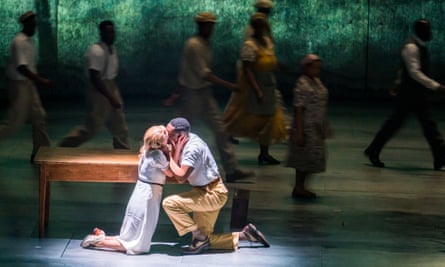 |
| A landmark in the National Theatre’s history’ ... Amy Forrest (Mrs Ryder) and CJ Beckford (Michael) in Small Island. Photograph: Tristram Kenton/the Guardian |
My Reaction: It felt like a gut punch to see Queenie not only left behind, but that the married fellow schoolteacher to be the one that Michael chose. You wonder, will she make it? Of course she will. This is another example of how she becomes stronger.
Significance: Repeatedly we see that Queenie is a stubborn, strong-willed woman. Her stalwart demeanor has cost her love and friendship, but in the end, it's this attitude that allows her the opportunity to go to England. This rejection builds her resolute manner.
__________________________
 |
| Hortense & Bernard - photo by Brinkhoff/Mögenburg (standard.co.uk) |
 |
| Hortense & Queenie meeting - photo by: Brinkhoff/Mögenburg (standard.co.uk) |
My Reaction: There is so much going on here. We see the openness and friendliness of Hortense to Blacks (which is clearly rare that this time) contrasted by Bernard's outward racism and dismissive nature. Both he and Gilbert had served in the military fighting the same war, but he cannot hide his hatred. We love Hortense for her willingness to help Gilbert and Queenie and continue to find Bernard just an awkward, unlikable guy. On top of this, we ache for Hortense because she's been doing her best with her husband gone. We assume he is dead, like she has, and feel she has the right to love and have this baby. With him in the picture, though, it changes things. We're wondering, what will happen next?
Significance: This is a turning point of the play. We fear that Gilbert and Queenie are going to be kicked out of the one place that they have been welcome, further straining this "dream" that they have had. We question race relations -- how will Hortense be able to care for a interracial baby during this time period? What allegiance does Hortense have to Bernard? Bernard represents most of the British society -- rejecting Blacks despite who were part of the Commonwealth and even fought in the warsd defending the country.
Saturday, May 2, 2020
Essential Information for Capstone
FlipGrid can be accessed HERE.
Zoom calls can be accessed HERE.
Romeo & Juliet scene can be accessed HERE.
Remaining Classes:
Zoom calls can be accessed HERE.
Romeo & Juliet scene can be accessed HERE.
Remaining Classes:
- Monday, May 4 -- Solidify calendar and directorial plans
- *Tuesday, May 5 (A2)
- Friday, May 8
- Wednesday, May 13
- *Thursday, May 14 (A2)
- Monday, May 18 -- Tech Rehearsal
- *Tuesday, May 19 (A2)-- Dress Rehearsal
- Friday, May 22 - Final Performances!!!
Due on Tuesday, May 5 (on your blog with link posted in the comments)
After having worked with your team director, you need to write up a plan for your director's vision.
DIRECTOR'S VISION
1. Write a succinct Director's Concept for your show/scene.
2. Your designated theatre theorist/tradition/style and justification for how this choice furthers your director's concept.
3. Application of Theory/Tradition into TEAM. Be sure to detail at least one specific moment of TEAM, including specifically where in the script and how you will apply the theory/tradition/style.
4. Design and Technical Elements: Outline the specific choices for these and how you envision using them throughout.
a. Setting (Time & Place)
b. Costumes
c. Music / Sound
d. Props
5. Recorded/edited? Performed Live?
Monday, April 27, 2020
Ideas for ways to apply your theory
In the comments below, write about 3 of the theories/traditions/styles that you would apply. Be sure to explain why you find them to be so intriguing.
Wednesday, March 25, 2020
Updated deadlines
Collaborative Project = Same deadlines as previously stated
Sunday, April 5 @ 9 pm--Draft of Collaborative Project Due
- No feedback will be given after this date/time
- You MUST share your work at this time.
Sunday, April 12 @ 9 pm [2.5 WEEKS FROM TODAY]
FINAL FINAL FINAL Collaborative Project Due
ABSOLUTELY NO EXTENSIONS WILL BE GRANTED.
------------
Quarter 3 Grades based on:
- Solo Project Performance & Prep
- Solo Project DRAFT
- Solo Project FINAL
------------
NEW Re-submitted EAs
**If** you would like to revise and improve any EA [Research Presentation, Director's Notebook, Solo Project], you can resubmit on or before April 6.
To be reassessed, you must:
ON THE RUBRIC -- Highlight and explain how you improved the specific section(s) you have revised. I will not re-grade anything that has not been explained thoroughly.
For example:
No Reassessment:Please grade Section A. I fixed comments and wrote more.- Reassessment: Please grade Section A page 2-3. In this section, I developed the idea of how the theory of meditation was found in Grimes' theatrical productions. I added specific examples and images in this section because it was quite simplistic before.
------------
Quarter 4 & Final IB grades based on:
- Final EA and IA grades submitted on April 6 (EAs) / April 5 (IA).
Thursday, March 19, 2020
Sample Solo Project Reports
From the IB:
Solo Project 1 (LePage)
Eliza's Solo Project Report LINK
Student Report: Robert Lepage
Other Solo Project Samples (from the IB):
Solo Project 1 (LePage)
Eliza's Solo Project Report LINK
Student Report: Robert Lepage
Other Solo Project Samples (from the IB):
- Student Report: Augusto Boal
- Student Report: Konstantin Stanislavsky
- Student Report: Steven Berkoff
Tuesday, March 17, 2020
First Online Class Meeting -- Weds. March 18
Today's Agenda
A) Check In & Document Share
B) General Feedback on Solo Project
C) Final Deadlines for Externally Assessed Projects for IB Submission:
Sunday, March 22 @ 9 pm
ABSOLUTELY NO EXTENSIONS WILL BE GRANTED. Whatever you have at Sunday, March 22 at 9 pm will be sent to the IB!
A) Check In & Document Share
B) General Feedback on Solo Project
C) Final Deadlines for Externally Assessed Projects for IB Submission:
Sunday, March 22 @ 9 pm
ABSOLUTELY NO EXTENSIONS WILL BE GRANTED. Whatever you have at Sunday, March 22 at 9 pm will be sent to the IB!
- Final Solo Project Report
- Any outstanding final pieces, including the Director's Notebook
D) Collaborative Project (IA):
Wednesday, March 25 @ 2:15-- Class Meeting via Zoom
BEFORE the next Zoom meeting, the following must be completed on YOUR BLOG & shared with Ms. G, Bia & Mr. Cabrera:
- Watch the show again!
- Re-read your Collaborative Project & Rubric (check your email/Google Drive -- keep in mind that the marks were for year 1 students not final pieces. I was generous!)
- Make a to-do-list of what's missing
- Create plan (with specific due dates) on how you will complete this
- Start working on revising the piece!
Helpful Collaborative Project Links:
- Collaborative Project RUBRIC
- Here's the link to "Dancing With Your Eyes Closed"
- Collaborative Project Images / Docs
- Student Samples (See previous post)
Deadlines:
Sunday, April 5 @ 9 pm--Draft of Collaborative Project Due
- No feedback will be given after this date/time
- You MUST share your work at this time.
Sunday, April 12 @ 9 pm [3.5 WEEKS FROM TODAY]
FINAL FINAL FINAL Collaborative Project Due
ABSOLUTELY NO EXTENSIONS WILL BE GRANTED.
Collaborative Project Samples
Tuesday, December 10, 2019
Tuesday, December 10 Classwork
Congrats for completing your Director's Notebook!!!
Now, we are moving on to the Solo Project, which is 33% of your final grade (so, the most important assessment!) Here's the plan for today:
- Intro to the project: Here is a helpful link for understanding the Solo Project and the requirements
- Breakdown the Solo Project Rubric -- What are the requirements? What do you have to actually do?
- Journal Writing: (Please put on your blog so I can read it!) The solo project is your final message to the Graded Community. It can be about you, about your views, your thoughts, your fears. BUT, it should be personal and meaningful. Spend some time to reflect on the big ideas that you are interested in exploring and why you would like to perform this piece.
- Theorist Exploration -- Take some time to review the online sources and books in my office. During these two days, I would like to you to find 5 theorists to preliminary research. On your blog, write about each of the five basic theories and how you imagine you might be interested in incorporating that theory into your work!
- PART A -- Theatre in Context COMPLETED
- Script written (or rights secured) for your play
________________________________________________
Theorist Resources:
- There's a shelf in my office dedicated to theorists. There's a class set of RED textbooks on the bottom shelf that gives you an in-depth overview of some theorists. (Please if you check one out, add it to the card and bulletin board!)
- Think about whether you want to experiment with PERFORMANCE or TECHNICAL aspects in your piece.
- Make sure whoever you choose has a clear system that you understand and can try out. If it's vague, it's going to be hard for YOU to clearly define and use in your piece!
- As always, West Sound Academy has a good list of theorists. It's not all of them, but it helps to give you an idea of where to start, with several resources!
- CLICK HERE for a list of possible theorists.
- Another link: https://sites.google.com/a/theatrenotes.org/ib-theatre/home/ipp/a-list-of-theorists
- Some possible technical theorists to check out: Robert Lepage, Robert Wilson, Adolpho Attia, Pamela Howard, Edward Gordon Craig, Julie Taymor
Thinking about your Solo Project
- What is your plan for the project?
- What are the main themes you will address in your piece?
- Will you write your own script or use an existing piece? If you use a published piece, what are the royalty costs?
- Why is this piece meaningful for you? Why do you want to put this piece on?
- What are you most excited to do in this piece?
- What are some of the issues you foresee with the piece? How will you problem-solve before it becomes an issue?
- What type of theory are you most interested in exploring? Performance? Technical?
- Who is the theorist you want to explore?
Sunday, December 1, 2019
Kabuki & Star Wars

Check out the Guardian's article about the upcoming piece:
Here's the recorded stream of the show:
Tuesday, November 26, 2019
Director's Notebook Deadlines
I will be handing back your feedback in the next day or two.
FINAL DIRECTOR'S NOTEBOOK due December 6 at 6 pm. NO EXCEPTIONS!
FINAL DIRECTOR'S NOTEBOOK due December 6 at 6 pm. NO EXCEPTIONS!
Monday, November 11, 2019
Assessing DN -- Part C
Part C -- What do you notice about the C Section? How would you score it using the IB Rubric?
- Director's Notebook #1: Athol Fugard "Nongogo"
- Director's Notebook #2: John Logan "Red"
- Director's Notebook #3: Brian Clark's "Whose Life is it Anyway?"
- EXTRA: Director's Notebook #4: Lee Hall "Pitman Painters"


Thursday, October 17, 2019

Tuesday, October 15, 2019
Hw #2: Director's Notebook Part A Research
You should have selected your play for your Director's Notebook. If not, make this a priority!
Begin working on the contextual research for Section A1. (The full Section A will be due on Friday, October 27.)
Also, as you reread the script, I would encourage you to take notes of your initial thoughts and ideas about the play!

Begin working on the contextual research for Section A1. (The full Section A will be due on Friday, October 27.)
Also, as you reread the script, I would encourage you to take notes of your initial thoughts and ideas about the play!
HW Part 1: Director's Concept for Clybourne Park
-->Using the formula we used in class, write a Director's Concept (Big Idea + Intention [the message as to what the audience walks away with]). Include a list of choices as to how your concept would guide your choices.
For example:
DIRECTOR'S CONCEPT: In "The Giver", I want to emphasize how our fear of the unknown allows us to relinquish our individuality and freedom.
STYLISTIC CHOICES: I will show this through the contrast between "sameness / conformity" and individuality.
Choices:
Performance:
Color Scheme:
For example:
DIRECTOR'S CONCEPT: In "The Giver", I want to emphasize how our fear of the unknown allows us to relinquish our individuality and freedom.
STYLISTIC CHOICES: I will show this through the contrast between "sameness / conformity" and individuality.
Choices:
Performance:
- Greetings -- All put up hand as leave & exit
- Apology
- Rituals (dinner) -- Synchronized movements
- Audience in arena staging -- all together
- Audience wears arm bands with logo
Color Scheme:
- Color vs. White/Grayscale
Costumes:
- White color, logo throughout
Props:
- All branded with the logo; devoid of color
- Drone
- Apple (without color)
- Books (changing from no color to with color)
Lights/Projections:
- Security footage throughout
- Color vs. No color
- Bright almost clinical vs. warm, colorful
Sound:
- Lack of music
- Sound of drone passing overhead
- Bells, tones that signal something
- Live music at the end of the performance
Director's Concepts Guiding Director's Choices
Example of Director's Choices in "Another Brick in the Wall"
Color Scheme: Red, Black and White
1. Strong colors chosen to show the strength of quick judgment, which is not often deeply analyzed, simply black and white.
2. Red is a passionate color and will read as such. It also is the color often associated with bricks.
3. COSTUME CHOICE: All cast members (except factory workers & crew members) will be dressed in variations of black, white and red.)
4. COSTUME CHOICE: Main character who breaks the pattern of judgment is NOT in black at the end of the show, like the others, but rather red.
5. COSTUME CHOICE: Factory workers (and crew members) must be distinguished as a separate group from the rest of the play. Their pieces are transition moments and times for the audience to evaluate what happened (Read: Brecht). They wear blue to contrast the red. Also, many manual laborers in Senegal wear these blue jumpsuits, so the audience will read them as such.
6. SET CHOICE: Sets and wall pieces are painted in these colors
Use of Wall/Brick Imagery
1) SET CHOICE: Huge wall will be built by factory workers/crew members each time a moment of judgment occurs. Eventually the wall will cover the whole front of the stage, blocking actors' pathway.
2) SET/ACTING CHOICE:At the end of the show, the actors will break out of their character and speak directly to the audience, knocking down the wall. They will declare that they are sick of the judgment.
3) SET CHOICE:Set will be a mix of different pieces of wall pieced together. It should not be one full wall. It should be pieced together with different types of wall (ie different pieces of judgment)
4) SOUND CHOICE:"Another Brick in the Wall" by Pink Floyd will be used for transitions to reiterate the idea of the wall of judgment growing and the passing of time.
Use of Factory to Represent Society
1) SET/ACTING CHOICE: To compliment the scenes of the baby-making factory, the Factory Workers will be omnipresent, overseeing what we do and influencing choices.
2) COSTUME CHOICE: Factory workers will be dressed differently (blue, see previous comment)
3) SET CHOICE:Factory will be on the 2nd floor, in shadows
4) ACTING CHOICE: Factory workers will enter after each scene to "clean up" from what occurred.
5) ACTING CHOICE: Factory workers will move mechanically throughout the play, which will further distinguish their differences from the others.
Thursday, October 10, 2019
Understanding a Director's Concept
A Director's Concept is the guiding statement that the director uses to guide the production. The director must take into account what CONCEPTS s/he wants to highlight through the use of stylistic devices throughout the show.
To create a DIRECTOR'S CONCEPT you must think about your BIG IDEAS & INTENTION (What you want to say about that big idea). What do you want to emphasize in this piece? After this, you need to think about what CHOICES you can make to make your intention clear.
Director's Concept:
1) BIG IDEA
2) INTENTION (WHAT)
3) Directorial Choices (HOW)
For example...
 |
| Seedfolks, courtesy of Susan Butler |
 | |
|
In Shrek, I wanted to emphasize what makes us different, makes us stronger. I chose to use contrast of organic lines and bright colors to contrast strong linear images and artificial, plastic materials.
In Shuddersome, I wanted to create a strong mood that heighten the audiences' awareness of the senses through use Day of the Dead imagery, light/shadow, sound and color choice.
In Another Brick in the Wall, I wanted to show that we build up walls when we judge people without knowing them fully, which is emphasized through the use of wall/brick imagery and a distinct color scheme of red, white and black, which was integrated into set and costume design.
 |
| Duloc Dancers & Lord Farquaad, Shrek |
In Shuddersome, I wanted to create a strong mood that heighten the audiences' awareness of the senses through use Day of the Dead imagery, light/shadow, sound and color choice.
 |
| Shuddersome, 2015, Courtesy of Emily Grimes |
 |
| Use of Black & Red to unify--Shuddersome, 2015, courtesy of Emily Grimes |
In A Curious Incident of the Dog in the Night-Time, Marianne Elliott wanted to show how Christopher's autism affects their perception of the world, which was emphasized through grids and linear imagery and gray-scale color scheme. Christopher’s discomfort was emphasized through harsh lighting, sound and movement.
 | |
 |
| Curious Incident of the Dog in the Nighttime, courtesy of ayoungertheatre.com |
 |
| Rehearsal--Breaking the Wall--Courtesy of Emily Grimes |


Subscribe to:
Posts (Atom)